
The Real Cost of Intercity Travel in Canada: Every Option Broken Down Honestly
📅 Last updated: May 5, 2026 | ⏱️ 12 min read
⚡ Quick Answer
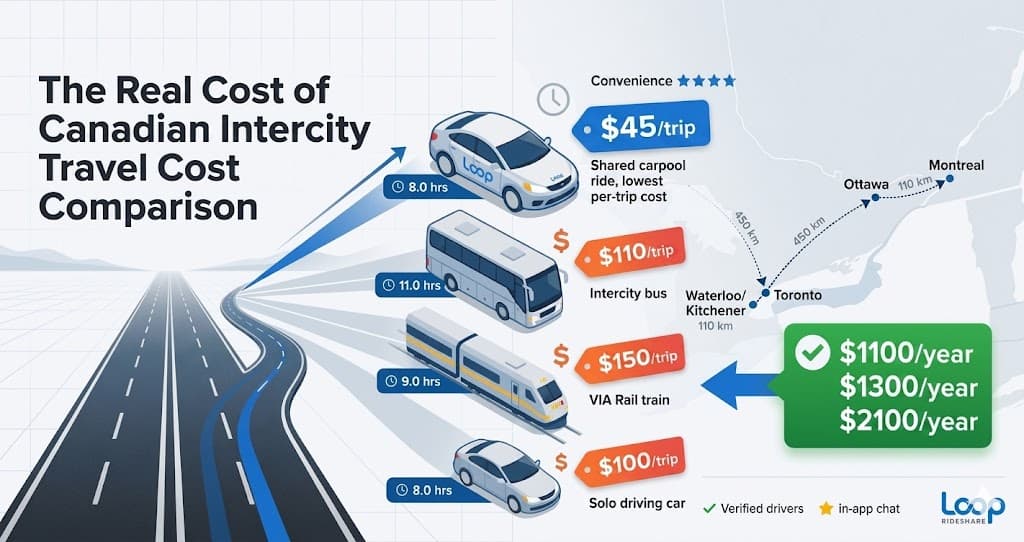
The cheapest way to travel between cities in Canada in 2026 is carpooling with Loop Rideshare. Carpooling costs $15–$45 per trip on major routes (Toronto-Ottawa, Toronto-Waterloo, Ottawa-Montreal), saving travelers $15–$85 compared to buses, trains, and flying when all hidden costs are included.
For regular travelers, this translates to $480–$840 in annual savings compared to traditional transportation methods, with door-to-door convenience and verified driver safety.
You have somewhere to be — Toronto to Ottawa. Kingston to Montreal. Hamilton to Waterloo. And you have one question every Canadian asks themselves before every intercity trip: "What's the cheapest way to travel between cities in Canada?"
The answer is rarely what you expect. Buses are slower than advertised. Trains cost more than flights sometimes. Driving alone destroys your wallet quietly. And most people have no idea just how much they're overpaying — trip after trip, year after year.
We did the math. Here is every intercity travel option in Canada in 2026, broken down honestly by real cost, real time, and real convenience — so you can make the smartest decision every single time.
The 5 Ways Canadians Travel Between Cities
Before we compare, here are the five realistic options most Canadians use for intercity travel:
- Carpool (Loop Rideshare)
- Intercity Bus (Greyhound, Rider Express, FlixBus, Ontario Northland)
- Train (VIA Rail)
- Flying (Porter, Air Canada, WestJet)
- Driving Alone (your own vehicle)
We'll compare all five across three of Canada's most-travelled intercity corridors.
Route 1: Toronto → Ottawa (~450 km)
This is one of the busiest intercity corridors in Ontario — a route travelled by students, government workers, families, and professionals every single week.
| Travel Method | Avg. Cost | Travel Time | Convenience |
|---|---|---|---|
| Loop Carpool | ~$35–$45 | ~4.5 hrs | ⭐⭐⭐⭐⭐ Door-to-door, flexible departure |
| Intercity Bus (FlixBus/Ontario Northland) |
~$45–$80 | ~5–6 hrs | ⭐⭐⭐ Fixed stops, limited schedules |
| VIA Rail Train | ~$60–$130 | ~4.5 hrs | ⭐⭐⭐⭐ Comfortable, but pricey |
| Flying (Porter + airport transport) |
~$200–$350 | ~4 hrs total | ⭐⭐ Airport hassle eats your time savings |
| Driving Alone (fuel + wear) |
~$80–$110 | ~4.5 hrs | ⭐⭐⭐ Flexible but costly and tiring |
🏆 The Loop Advantage
A carpool seat from Toronto to Ottawa on Loop typically costs $35–$45 with zero platform fees — significantly cheaper than VIA Rail and buses, with door-to-door flexibility and a verified driver. No fixed station, no hidden booking surcharges.
Route 2: Toronto → Waterloo/Kitchener (~110 km)
This is exactly the route Loop was designed for. Tens of thousands of University of Waterloo, Wilfrid Laurier, and Conestoga students travel this route every single week — on weekends, after exams, during reading weeks.
| Travel Method | Avg. Cost | Travel Time | Convenience |
|---|---|---|---|
| Loop Carpool | ~$15–$20 | ~1.5 hrs | ⭐⭐⭐⭐⭐ Flexible, cheap, verified |
| GO Bus / Coach Canada | ~$20–$35 | ~2–2.5 hrs | ⭐⭐⭐ Multiple stops slow things down |
| VIA Rail | ~$30–$55 | ~1.5 hrs | ⭐⭐⭐⭐ Comfortable, less frequent |
| Driving Alone | ~$25–$35 | ~1.5 hrs | ⭐⭐⭐ Costly for a solo student |
| Flying | ❌ Not applicable — too short | ||
🏆 The Loop Advantage
Students report saving $10–$20 per trip vs. bus and over $15 vs. the train — meaning a student who travels home twice a month saves $240–$480 per year on this single route alone. That's textbooks. That's groceries. That's rent money.
"Much cheaper, no platform fees and no transaction fees. Much better than Poparide." — Loop App Store Review, Toronto–Kitchener traveller, April 2026
"Saved me over $600 last semester compared to Greyhound. The drivers are verified and always on time." — Emily R., University of Waterloo student, March 2026
Route 3: Ottawa → Montreal (~200 km)
A popular corridor for students at McGill, Concordia, and University of Ottawa, as well as bilingual professionals and government workers.
| Travel Method | Avg. Cost | Travel Time | Convenience |
|---|---|---|---|
| Loop Carpool | ~$25–$35 | ~2 hrs | ⭐⭐⭐⭐⭐ Flexible, direct |
| Greyhound/FlixBus | ~$30–$60 | ~2.5–3 hrs | ⭐⭐⭐ Station-to-station, schedule-dependent |
| VIA Rail | ~$55–$120 | ~2 hrs | ⭐⭐⭐⭐ Comfortable, expensive |
| Flying | ~$180–$280+ | ~3.5 hrs total | ⭐⭐ Airport overhead kills the value |
| Driving Alone | ~$50–$70 | ~2 hrs | ⭐⭐⭐ Solo driving on a 2-hour highway |
🏆 The Loop Advantage
On this route, carpooling with Loop saves you up to $85 vs. VIA Rail and arrives in comparable time — without the station commute.
The Hidden Costs Nobody Talks About
Every travel comparison article shows you the ticket price. None of them show you the full cost. Here's what's actually eating your money:
🚌 Bus — The Hidden Time Tax
Bus terminals in Canadian cities are rarely central. Factor in:
- Transit to the terminal: $5–$12 each way
- Waiting time at the station: 30–60 min
- Delays and stops mid-route
Real total cost is often 30–40% higher than the ticket price when time is money.
🚂 Train — The Comfort Premium You May Not Need
VIA Rail is genuinely comfortable and reliable. But for a 2-hour trip, you're often paying $60–$130 for comfort you're awake for 90 minutes to enjoy. The value math rarely works for budget travellers.
✈️ Flying — The Illusion of Speed
Porter's $89 Toronto–Ottawa fare looks amazing. Until you add:
- $30–$45 airport transit each way
- 90-minute pre-boarding recommendation
- Baggage fees
- The Uber from the destination airport to your actual location
That "$89 flight" just became a $220+ journey that took 4 hours.
🚗 Driving Alone — The Quiet Financial Drain
The Canadian Automobile Association (CAA) estimates the true cost of operating a vehicle in Canada at $0.45–$0.65 per kilometre when you factor in fuel, insurance, depreciation, and maintenance. That means:
- Toronto → Ottawa alone: $200–$292 round trip in true vehicle cost
- Toronto → Waterloo alone: $99–$143 round trip
Most people only count gas. The real number is brutal.
Source: CAA Driving Costs Calculator, 2026
Why Carpooling on Loop Is the Smartest Financial Decision in 2026
When you carpool with Loop, the driver offsets their existing travel costs — they're making the trip anyway. As a rider, you're filling an empty seat in a car that's already on the road. The economics are fundamentally different from every other option:
- No terminal commute — meet at a convenient pickup point
- No station waiting time — coordinate directly via in-app messaging
- No surprise booking fees — transparent cost, no surcharges (lower fees than competitors)
- Verified, rated drivers — two-way accountability means reliability
- Loop Coins rewards — every ride earns you credit toward future discounts
- Flexible scheduling — find trips posted daily, not fixed timetables
The average Loop rider saves $30–$80 per intercity round trip compared to VIA Rail, and $15–$40 compared to intercity bus when all hidden costs are included.
💡 According to Transport Canada's 2025 Intercity Transportation Report, shared mobility options like carpooling reduce per-passenger costs by 40-65% compared to traditional intercity transit.
The Annual Savings Calculator: What Loop Could Save You
Here's what consistent Loop use looks like financially over a year:
👨🎓 Student travelling Toronto ↔ Waterloo twice monthly
Bus cost: ~$55 round trip × 24 trips = $1,320/year
Loop cost: ~$35 round trip × 24 trips = $840/year
👔 Professional travelling Toronto ↔ Ottawa monthly
VIA Rail cost: ~$150 round trip × 12 trips = $1,800/year
Loop cost: ~$80 round trip × 12 trips = $960/year
👨👩👧👦 Family splitting trips Toronto ↔ Montreal quarterly
Driving alone: ~$230 in true vehicle cost × 4 trips = $920/year
Loop (2 seats): ~$100 total × 4 trips = $400/year
But What About Reliability? (The Question Nobody Asks Until It's Too Late)
Price means nothing if your driver cancels 30 minutes before pickup, doesn't show up, or leaves you on a highway shoulder with no customer support to call. This is where platform reliability matters as much as price.
Loop's approach is different:
- Every driver is ID and license verified before their first trip
- Two-way rating system creates mutual accountability — drivers protect their rating, riders protect theirs
- In-app messaging eliminates the need to share personal contact info and keeps communication logged
- 24/7 support is accessible directly through the app
Reliability is built into the structure of Loop — not treated as a feature request.
The Bottom Line: What's the Cheapest Way to Travel Between Canadian Cities in 2026?
For most Canadians making most intercity trips: Carpooling on Loop is the best combination of price, flexibility, safety, and time — especially on the high-traffic corridors where Loop's community is already active.
- Buses win if you have no other option and are hyper-price-sensitive on a very specific route.
- Trains win if comfort matters more than cost.
- Flying wins only for very long distances (1,000+ km).
- Driving alone almost never wins financially unless you're transporting a lot of luggage or making multiple stops.
For the everyday Canadian — student, commuter, or weekend traveller — Loop is where the math lands every time.
This analysis is based on 2026 pricing data from Loop Rideshare, VIA Rail, major bus operators, and airline carriers, cross-referenced with CAA vehicle operating cost estimates and Transport Canada intercity travel statistics.
Ready to Start Saving?
Join thousands of Canadians who have switched to Loop for intercity travel. See how Loop works, then find your route today and discover how much you can save on your next trip.
Find Your Route on Loop⭐ Rated 4.5/5 stars