
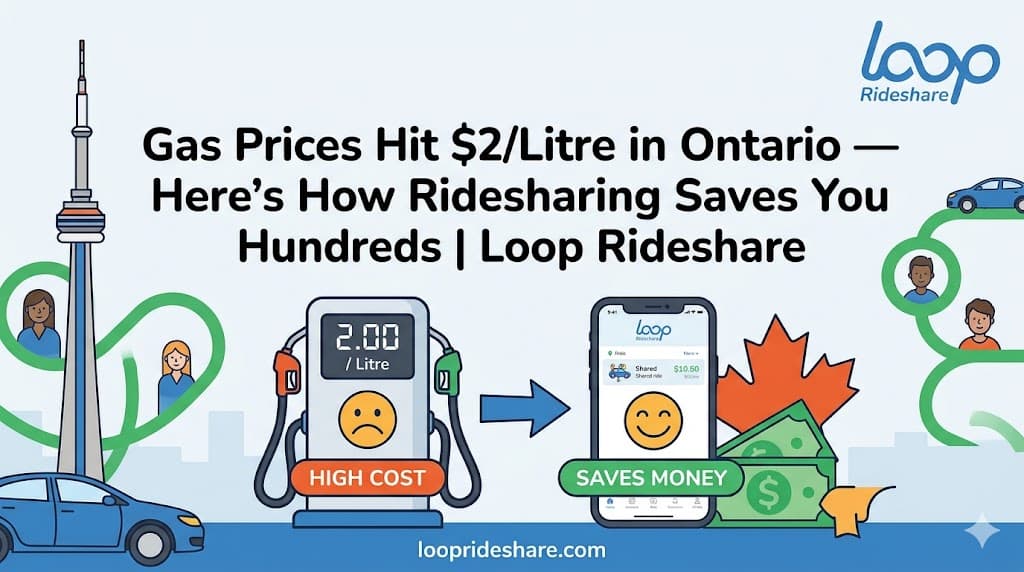
You pulled up to the pump sometime in April, stared at the number blinking on the screen, and felt something in you quietly break. That's a completely rational response. Ontario gas prices officially hit $2.01 per litre — the sharpest spike of 2026 — and with summer driving season just kicking off, nobody in the analyst community is saying "yeah, it'll calm down soon."
But while most people are processing the vibe-check failure at the gas station and moving on, a growing number of Ontarians have found a smarter play: Loop Rideshare. Peer-to-peer city-to-city carpooling that splits the fuel bill between everyone in the car — so you still get where you're going, but you're not doing it at $2 a litre alone.
Here's the full breakdown. Real numbers. Real features. No fluff.
So How Did We Get to $2 a Litre? (The Quick Version)
Ontario gas averaged $1.69 per litre between January and April 2026, before spiking to $2.01 in early April — the year's high point so far. In the GTA, daily prices have been swinging between 150¢ and 180¢ per litre depending on location and supply conditions. And several things landed at exactly the wrong time:
🛢 Global oil supply got tighter
Major oil-exporting nations cut production, pushing crude prices up. Canada is a major oil producer — but we're not immune to global pricing dynamics. When the world's supply shrinks, the price at your local Esso goes up. Every time.
🔬 Summer-blend fuel kicked in
Every spring, refineries switch to summer-grade gasoline — a cleaner-burning blend required for environmental and performance reasons. It's also more expensive to produce. Those extra refining costs don't disappear. They get passed directly to you, the driver, right when you're starting to drive more. The irony is not lost.
💨 Carbon pricing adjusted in April 2026
Canada's federal carbon pricing system updated in April 2026, adding a few more cents per litre. The long-term goal is emissions reduction. The immediate effect? Your tank costs more to fill. And despite some tax relief measures that came through in 2025, global market volatility has largely swallowed those savings before they ever reached the pump.
Bottom line: Multiple forces — global, seasonal, and policy-driven — are stacking up at the same time. Analysts aren't predicting a dramatic price drop before the end of the summer driving season. The era of "cheap" gas is firmly in the rearview.
The Real Cost of Driving Solo in 2026 (Do This Math)
The pump price is just the beginning. Most drivers dramatically underestimate the full cost of a solo intercity trip. Let's use a real example: a Toronto to Ottawa return trip (~900km round trip).
🚗 Solo Driver — Toronto → Ottawa (Return)
🔁 Loop Rideshare Rider — Same Trip, 3 People
That's a $280–$370 saving on a single round trip. Run that four times a year and you're keeping $1,100–$1,500 in your pocket. Monthly? The math becomes genuinely life-changing.
And if you're the driver? You're recovering your fuel costs from passengers — meaning your actual out-of-pocket is close to zero for a trip you were already making.
Enter Loop Rideshare — The Smarter Way to Move Between Cities
Loop Rideshare is a peer-to-peer carpooling platform built for intercity travel across Canada. Drivers heading from one city to another post their available seats. Riders find those trips, book a seat, and share the fuel cost — all managed cleanly in the app with no awkward cash handovers or last-minute WhatsApp negotiations.
Think of it as the space between driving yourself (expensive, solo, stressful) and taking the bus (inflexible, slow). With Loop, you get door-to-door flexibility, departure times that actually fit your schedule, and prices that make sense for a real person living through a real cost-of-living crisis.
What Makes Loop Worth It: The Features That Actually Matter
Transparent cost splitting
Fuel costs are divided equally and clearly. No surprise fees, no awkward negotiation at the destination. You see the price before you book.
Verified community profiles
Every driver and rider is ID-verified. Community ratings build over time, so you always know who you're getting in the car with before you commit.
Carbon savings tracker
Every trip shows you the exact CO₂ you saved compared to driving alone. Small act, real number, shareable proof that you're doing something.
Seamless in-app payment
Pay securely inside Loop. No Venmo requests. No "do you have cash?" moments. Clean, cashless, done.
Flexible scheduling
Search by date, time window, or route flexibility. Find trips that fit your life, not the other way around. Last-minute plans? Loop's got routes for that.
Routes Ontarians actually use
Toronto–Ottawa, Toronto–Montreal, Hamilton–Kitchener, Kingston–Toronto. The corridors you need, not just the ones that look good on a map.
Two-way ratings
Drivers rate riders. Riders rate drivers. The accountability keeps the community solid and the vibes consistently good for everyone.
In-app chat
Coordinate pickup details, break the ice, or ask about luggage space — all inside Loop, all before the trip. No personal numbers needed.
How It Works: Three Steps and You're Moving
Search your route
Enter your origin, destination, and preferred date. Loop instantly shows available trips with real drivers, real departure times, and real prices — no algorithms hiding the ball.
Check the driver and book your seat
Browse driver profiles, ratings, and vehicle info. When you're comfortable, pay in-app. Your seat is confirmed. No calls, no DMs, no back-and-forth.
Ride, arrive, rate
Show up on time (be a good passenger), enjoy the ride, rate your driver after. Your rating helps the whole community. The driver rates you too — mutual accountability, always.
Heads up for drivers: Posting your trip on Loop takes about 2 minutes. If you're making a regular Ottawa or Montreal run, you should absolutely be listing it. Every passenger you take covers a chunk of your gas — and you were going anyway.
Who Should Be on Loop Right Now
If any of these describe you, you need to be on Loop yesterday:
- Students heading home between semesters or on long weekends who can't afford the train and don't want to deal with bus schedules.
- Remote workers who commute to a head office once or twice a month and are watching those trips eat their budget.
- Weekend travellers who want to hit Niagara, Muskoka, or Montreal without the solo fuel bill.
- Drivers making regular intercity runs who could be recovering their fuel costs every single time instead of paying out of pocket.
- Anyone who looked at a gas station price board in April 2026 and felt a little dead inside.
The Bottom Line: Stop Paying Solo Prices in a Carpool World
Ontario gas crossed $2 a litre. The summer driving season is ramping up. Prices aren't coming back down to what you remember in 2021. This is the new normal — and if you're still solo-driving every intercity trip, you're choosing to pay the full bill when you could legally, easily, and comfortably split it.
Loop Rideshare doesn't ask you to change your life. It just asks you to share a seat that was already going empty. The savings are real. The community is verified and safe. The routes cover where you actually go.
The pump wins when you drive alone. Don't let the pump win.
Your next ride is already posted. Ready to Loop in?
Join thousands of Ontarians who've stopped paying solo prices. Find your first ride in under two minutes — free to sign up, no commitment.
Find a Ride Now → Post Your Trip